


Hajj vs Umrah: Understanding the Key Differences, Similarities, and Spiritual Importance
Every year, millions of Muslims travel to the holy city of Makkah to perform one of Islam’s most sacred acts of worship. While both Hajj and Umrah are pilgrimages to the House of Allah, they differ in their obligation, rituals, timing, and significance. Understanding these differences helps every Muslim prepare for a meaningful spiritual journey.
Hajj is a mandatory, five-day pilgrimage and the fifth pillar of Islam, performed annually on specific dates in the lunar month of Dhul-Hijjah. Umrah is a voluntary, “lesser” pilgrimage that can be completed in a few hours and undertaken at any time of the year.
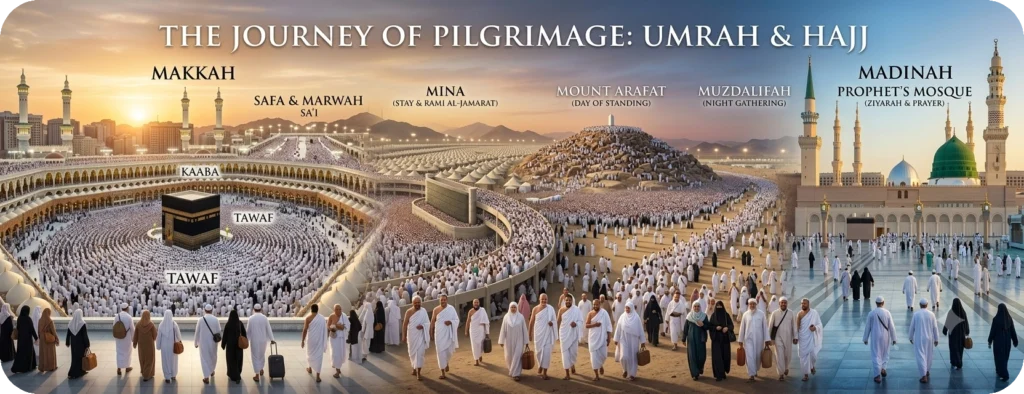
While both involve entering a sacred state (Ihram) and traveling to Makkah to circumambulate the Kaaba (Tawaf) and walk between Safa and Marwah (Sa’i), they differ significantly in several key areas:
Quranic References :
“And complete the Hajj and ‘Umrah for Allah…”
Surah Al-Baqarah (2:196)
Key Differences at a Glance
| Feature | Hajj | Umrah |
| Status | Mandatory (Fard) for all able-bodied and financially capable Muslims. | Voluntary (Sunnah) and highly recommended, but not compulsory. |
| Timing | Restricted to fixed days in the Islamic month of Dhul-Hijjah (typically 8th to 12th/13th). | Can be performed at any time of the year. |
| Duration | Takes about 5 to 6 days to complete all required rites. | Can usually be completed in just 3 to 6 hours. |
| Additional Rituals | Involves complex rituals including staying in Mina, standing at Mount Arafat, staying in Muzdalifah, and stoning the pillars (Rami). | Does not include staying in Mina, Muzdalifah, Arafat, or stoning the pillars. |
On the Rites of Safa & Marwah:
“Indeed, as-Safa and al-Marwah are among the symbols of Allah. So whoever makes Hajj to the House or performs ‘Umrah—there is no blame upon him for walking between them…”
Surah Al-Baqarah (2:158)
What Is Umrah?
Umrah is a voluntary Islamic pilgrimage to Makkah that can be performed throughout most of the year. Often called the “lesser pilgrimage,” Umrah is not one of the Five Pillars of Islam, yet it is a highly recommended Sunnah of Prophet Muhammad ﷺ.
During Umrah, Muslims leave behind worldly distractions and devote themselves entirely to the worship of Allah. The journey provides an opportunity to seek forgiveness, strengthen faith, make sincere du’a, and renew one’s relationship with the Creator.
Unlike Hajj, Umrah can usually be completed within a few hours, making it accessible for Muslims who wish to visit the Sacred Mosque outside the Hajj season.
Quranic References :
“…And [due] to Allah from the people is a pilgrimage to the House—for whoever is able to find thereto a way.”
Surah Ali ‘Imran (3:97)
ajj is the annual pilgrimage to Makkah and the fifth pillar of Islam. Every Muslim who is physically, financially, and mentally capable must perform Hajj at least once in their lifetime.
What Is Hajj?
Hajj takes place only during the days of Dhul Hijjah, the twelfth month of the Islamic calendar. Millions of pilgrims from every corner of the world gather to perform the same acts of worship, demonstrating unity, equality, and complete submission to Allah.
Allah says in the Qur’an:
“And pilgrimage to the House is a duty owed to Allah by all people who are able to undertake it. Whoever disbelieves, then surely Allah is free of need from all the worlds.”
(Surah Aal ‘Imran 3:97)
Main Differences Between Hajj and Umrah
1. Obligation
Hajj
- One of the Five Pillars of Islam.
- Obligatory once in a lifetime for every eligible Muslim.
Umrah
- A voluntary act of worship.
- Highly recommended but not compulsory.
2. Time of Performance
Hajj
- Can only be performed during the specific days of Dhul Hijjah.
Umrah
- Can be performed at almost any time of the year, except during certain periods connected to Hajj for specific pilgrims.
3. Duration
Umrah
- Usually completed in 3–6 hours.
Hajj
- Takes approximately 5–6 days, depending on the pilgrim’s schedule.
4. Rituals
Umrah Rituals
Pilgrims perform:
- Entering the state of Ihram
- Tawaf around the Kaaba
- Sa’i between Safa and Marwah
- Halq (shaving the head) or Taqsir (trimming the hair)
Hajj Rituals
Hajj includes all major acts of Umrah plus additional rituals such as:
- Staying in Mina
- Standing at Arafat
- Spending the night in Muzdalifah
- Stoning the Jamarat
- Offering a sacrifice (for applicable pilgrims)
- Farewell Tawaf
Similarities Between Hajj and Umrah
Although they differ in several ways, Hajj and Umrah share many important features.
Both pilgrimages:
- Are performed in the holy city of Makkah.
- Begin with entering the state of Ihram.
- Include Tawaf around the Holy Kaaba.
- Include Sa’i between Safa and Marwah.
- End with shaving or trimming the hair.
- Bring Muslims closer to Allah through worship, remembrance, and repentance.
- Follow the Sunnah of Prophet Muhammad ﷺ.
Is Hajj More Difficult Than Umrah?
Generally, yes.
Hajj is more physically and emotionally demanding because it lasts several days and includes additional rituals performed in Mina, Arafat, and Muzdalifah.
Pilgrims also experience:
- Long walking distances
- Large crowds
- Hot weather
- Overnight stays in tents or open areas
- Strict ritual timings
Despite these challenges, Hajj remains one of the most rewarding experiences in a Muslim’s life.
Can Umrah Replace Hajj?
No.
Performing Umrah does not fulfill the obligation of Hajj.
Even if a Muslim performs Umrah many times, the duty of Hajj remains if they become financially and physically able.
Does Umrah During Ramadan Equal Hajj?
The Prophet Muhammad ﷺ said:
“Umrah during Ramadan is equal in reward to Hajj with me.”
(Sahih al-Bukhari and Sahih Muslim)
This means the reward is comparable, but it does not replace the obligation of Hajj.
Benefits of Performing Hajj and Umrah
Both pilgrimages offer immense spiritual rewards, including:
- Seeking Allah’s forgiveness
- Strengthening faith (Iman)
- Purifying the heart and soul
- Following the Sunnah of Prophet Muhammad ﷺ
- Increasing patience and gratitude
- Uniting Muslims from every nation
- Gaining a deeper appreciation for Islamic history
Final Thoughts
Hajj and Umrah are among the greatest acts of worship in Islam. While Hajj is an obligatory pillar for those who are able, Umrah is a beautiful voluntary pilgrimage that allows Muslims to draw closer to Allah throughout the year.
Whether you are planning your first Umrah or preparing for Hajj, learning about their rituals and significance helps make your journey more meaningful. May Allah accept the worship of all pilgrims and grant every Muslim the opportunity to visit His Sacred House. Ameen.
Whether you are planning your first Umrah or preparing for Hajj, learning the rituals and understanding their significance will help you perform these sacred journeys with sincerity and devotion.
May Allah accept the Hajj and Umrah of every pilgrim and grant all Muslims the opportunity to visit His Sacred House. Ameen.